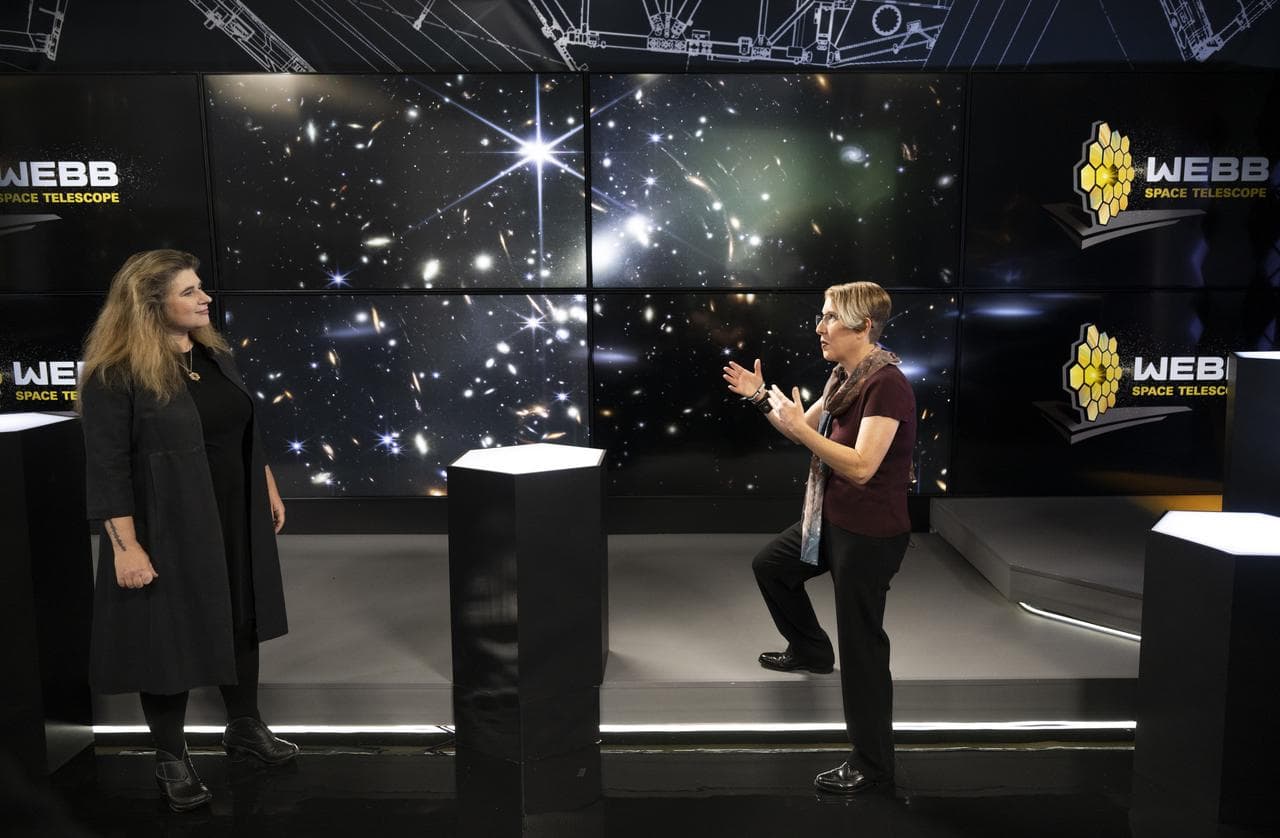
The James Webb Space Telescope (JWST) is a 6.5-meter infrared observatory parked at a gravitationally stable point called L2, about a million miles from Earth. Its gold-coated mirror is six times larger in area than Hubble's, and its instruments see infrared light that lets it look through dust clouds and back toward the first galaxies.
Webb launched on Christmas Day 2021 and unfolded itself in space over six months, a deployment with over 300 single points of failure that all worked. Its first images arrived in July 2022, and it has since found galaxies forming earlier and growing faster than models predicted.
Webb sees the universe as it was over 13 billion years ago, closer to the Big Bang than any telescope before it. It can also read the chemistry of atmospheres on planets orbiting other stars, the most direct search for life beyond Earth ever attempted.
Key Facts
- Launched
- December 25, 2021
- Location
- Sun-Earth L2, about 1 million miles from Earth
- Mirror
- 6.5 meters, 18 gold-coated segments
- Sees in
- Infrared (0.6 to 28.5 microns)
- Partners
- NASA, ESA, and the Canadian Space Agency
Timeline
December 2021
Launch aboard Ariane 5 from French Guiana
January 2022
Sunshield and mirror fully deployed; arrives at L2
July 2022
First full-color images released, including the deepest infrared view of the universe
Next up
Continued observation cycles; fuel supports 20+ years of science
Latest James Webb Space Telescope News

Webb reveals millions of stars in nearby galaxy
In new images from the NASA/ESA/CSA James Webb Space Telescope to celebrate its fourth science anniversary, a familiar galaxy transforms into something far richer, and far more complex, than ever seen before. Webb’s unpr
James Webb Space Telescope

NASA Webb Uncovers Unusual Galaxy Shaped by Cosmic Collision
In new images from NASA’s James Webb Space Telescope to celebrate its fourth science anniversary, a familiar galaxy transforms into something far richer, and far more complex, than ever seen before. Webb’s unprecedented
James Webb Space Telescope

NASA’s Webb Reveals Stars Sparking to Life in Cosmic Celebration
NASA’s James Webb Space Telescope has captured the infrared light of numerous features that previously were impossible to see beyond the thick dust of the FS Tau star system. In addition to myriad background galaxies tha
James Webb Space Telescope

NASA’s Webb Studies How Planet Survived Death of its Star
NASA’s James Webb Space Telescope is giving us new insight into the far-future of solar systems like our own, as the agency continues to reveal the secrets of the universe and our place in it. Billions of years ago, a Su
James Webb Space Telescope

Webb studies how a planet survived the death of its star
An international team of astronomers has used the NASA/ESA/CSA James Webb Space Telescope to watch the Jupiter-sized exoplanet WD 1856 b transit its host star, measuring the planet’s mass and temperature and even detecti
James Webb Space Telescope

Millions of Stars in Cigar Galaxy
NASA’s James Webb Space Telescope recently observed edge-on starburst galaxy Messier 82 (M82), nicknamed the Cigar Galaxy. Webb’s new view of M82, added to archival data from NASA’s Hubble Space Telescope, gives us a mor
James Webb Space Telescope
Hubble Space Telescope

NASA’s Webb Pinpoints Millions of Stars Within Cigar Galaxy
Located 12 million light-years away and undergoing rapid star formation, edge-on spiral galaxy Messier 82 (M82) is a scientifically unique sight to behold, and now NASA’s James Webb Space Telescope has revealed previousl
James Webb Space Telescope

NASA’s Webb Finds Clues to Ancient, Distant Origin of Comet 3I/ATLAS
As interstellar comet 3I/ATLAS began moving away from the Sun in December 2025, astronomers took the opportunity to turn NASA’s powerful James Webb Space Telescope in its direction and capture detailed measurements of it
James Webb Space Telescope

Stages of Star Formation
This image, captured by NASA’s James Webb Space Telescope and released on June 5, 2026, shows just a small portion of one of the Orion Molecular Clouds, a long and massive filament of cold gas and dust beyond the Orion N
James Webb Space Telescope
Orion and SLS

NASA’s Webb Catches Exoplanet Getting Roasted
One well-done gas giant, coming right up! That’s the latest from researchers analyzing NASA’s James Webb Space Telescope’s observations of HD 80606 b, an exoplanet four times the mass of Jupiter with an extremely ellipti
James Webb Space Telescope

NASA Webb, Hubble Reveal History of Relic of Milky Way’s Formation
Researchers using two of humanity’s most powerful observatories — NASA’s James Webb and Hubble Space Telescopes — have definitively shown that Terzan 5 is not a globular star cluster as it was once classified, offering n
James Webb Space Telescope
Hubble Space Telescope

Black Eye Galaxy
This March 20, 2026, image of Messier 64, or the Black Eye Galaxy, is a composite view from NASA’s Hubble Space Telescope and James Webb Space Telescope. It shows Messier 64 captured at near- and mid-infrared wavelengths
James Webb Space Telescope
Hubble Space Telescope

NASA Webb Finds Strongest Evidence Yet for ‘Black Hole Stars’
The complex puzzle known as little red dots has become more complete since their initial discovery by NASA’s James Webb Space Telescope in 2022. Now a particular little red dot’s spectrum is helping connect many of the p
James Webb Space Telescope
Facts last reviewed 2026-07-11. Official mission page: science.nasa.gov
